Sunday, January 16, 2011

Nazi Propaganda Posters

The Caption on the above poster reads "Healthy Parents Have Healthy Children". On your post please do the following:
1. Describe what you see in the picture. Consider color, placement, people and objects, and composition. Everything that you see.
2. Interpret: Guess about the creator is trying to express through the caption and images. Why is this message being conveyed?
Evaluate: What is the intended purpose of this image? The intended audience? Does the image achieve its purpose?

1. In the poster you can see a very 'ideal' family. First of all, the family is at the center of the poster, grabbing people's attention. The happy family stands out from the dark background. It's hard not to notice the huge smiles on each of their faces. All members of the family look smart, fit, and content. The father figure looks tall and proud, and so does his son. The boy is wearing a uniform, and he looks like a young determined soul. The mother and the girls look like they are having a wonderful life. Besides the boy, they all are dressed 'traditionally'. The familiy seems to be perfect.

2. The father gives the impression that there is absolutely no doubt that he can lead and protect his family. The boy's uniform and eagerness suggests that he is a member of Hitler Youth. The fact that they are wearing traditional clothes show that they are probably a very 'German' family. The creator is trying to give hope to the audience hope by saying the Nazi Party can restore Germany's health and that their families' state can be as good as the ones in the posters. The message gets through because as I mentioned before, it is an ideal family. People would see this poster and think that they want a family just like that. The intended purpose of this image is to get people to believe that voting for the Nazi Party can really solve your problems. This poster is probably aimed at the adults. The poster definitely achieves its purpose for not only does the 'perfect' family grab attention, but gives hope to the people who are caught in the middle of the depression.

Friday, January 14, 2011

Propaganda

(That is to blame for the war)

Today we studied some of the aspects of propaganda and its uses, particularly in regard to Nazi Germany. First of all, answer this question: What is the definition of the word propaganda? Next, why was it used so extensively by Hitler and the Nazis?

The definition of propaganda is spreading information or ideas that are misleading and bias purposely to help promote a movement, a person or a group such as the NSDAP (Nazi Party). Hitler and the Nazis used propaganda a lot because they had little success in the 1928 election, and they needed a way to attract attention from the public and seem appealing. They used their posters to send strong messages that weren't necessarily true. They made the Jews look bad by describing them as the traitors and the reason for Germany's economic failure, while they promoted their party by having paintings of happy families and strong, proud teenagers that contrast from the Jews.

Source of image:

Thursday, January 13, 2011

Where does Eric von Ronheim stand?

Briefly describe the person that you represented in today's activity. Then, state the poitical party you think that the person would vote for in an election. Be sure to give specific reasons for this choice! Besides agreeing with what a political party stands for, what other factors might be involve in a person's voting decision?

Eric von Ronheim is a German who owns a textile factory. He is against the Treaty of Versailles, because he has to pay heavy taxes and he believes if the treaty didn't exist, Germany would be in a better state. Because people have to pay the taxes many people don't have money to buy products from his company. In addition he believes that the taxes won't go down even when the depression ends. Ronheim fears the comunnists, because he thinks capitalists like him won't be respected any more, and he thinks that Germany will become obedient to the Russians.

I think that Eric von Ronheim would vote for the Nazi Party. I think so because first of all, Ronheim does not like the Treaty of Versailles at all, and one of the points on the Nazi Party Program is abolition to the Treaty of Versailles. Another reason is that Ronheim is person who has to pay a lot of taxes, and he thinks that the taxes won't go down even after the depression because Germany would still have to pay the French. The Nazi Party had declared abolition against the treaty, and that would end Ronheim's problems wth taxes. On top of that, Hitler and the Nazi Party didn't like communists such as the Russians. The Nazi Party would seem appealing to Ronheim because he doesn't like the communists either. A factor that affects a person's voting decision is whether or not the party will take action on things that will benefit that person.

Monday, January 10, 2011

"Anger and Humiliation" & "Voices in the Dark"

Read and annotate "Anger and Humiliateion" with questions and comments. Make specal note of the description of Adolf Hitler. Highlight any clues or statements on his personality, personal life, beliefs. In class on Tuesday we will be making an identity chart of him. Also, on pg.124, carefully read the Nazi Party program. Choose two points of this program that you think are epecially unfair. Why are they unfair? Which one do you have questons about?
Then, read "Voices in the Dark". Annotate with questions an comments. Then, answer this question: If you had been on the train do you think you would have said or done anything? Have you or someone you know ever had a similar experience?

The two points of the Nazi Party program that I think is the most unfair are #5 & 8. #5 states that, "Non-citizens can live in Germany only as foreigners, subject to the law of aliens." I think this is not right because although I understand that they do not want non-Germans as citizens of their country, the foreigners should still be treated equally. They might not get all the benefits of a citizen such as voting, but I believe that they should be respected of their place. They might not originaly be from Germany, but they are people who came to live there, and they should be treated the same; not like an object the government just decides to toy with and throw away. Point 8 says that, "No further immigration of non-Germans. Any non-German who entered Germany after August 2nd, 1914, shall leave immediately. " I do not have so much problem with the first part of the statement, but the second part bothers me. This Nazi Party program was created in February 1920, and that means that the people who are subject to this point are either; have gotten accustomed to Germany, is getting settled in, or ones who just arrived. These foreigners might still be in the process of "fitting in" and for the party to tell them to just leave them is absurd. These people might have thrown away everything to move to Germany, and they might not even have anywhere to go.

If I were positioned as the Jew in the train, I'm not sure if I would have fully stood up to them. I would probably say that I disagree in a quite voice without stating the fact that I was Jewish. It might seem cowardly but honestly I don't think I would have the courage to stand up to seven or eight other people, who especially are pointing their anger directly at my kind of people. I have been in these kinds of situations a few times, but of course not as intense. I don't recall the details but I do remember that I mumbled my disagreements about what they were saying. I do remember feeling extremely awkward wondering, 'How can they just assume that I agree with them?'

Monday, December 13, 2010

Religions Field Trip Photos

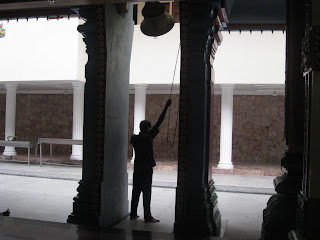
On the bottom-left is a picture of lotuses inside the Chinese temple. The picture on the top-right is a man ringing a bell inside the Hindu temple. The picture on the left is a fountain inside the mosque. The fountain is the shape of a star with 8 points.


Sunday, December 12, 2010

ID Chart: An Inmate in Auschwitz


Religions Field Trip Reflection

Yesterday we toured a mosque, a Chinese temple, and a Hindu temple. These places of worship are located in the oldest part of the city of Kuala Lumpur. As a result, the area is very rich culturally and is full of interesting sights, sounds and activities. On your blog, post at least one photograph from each place of worship. Describe the photo and what it shows. Then in your reflection, compare and contrast the religious places we visited. What was similar? What was different? What are the common values that these religions might hold? Finally, which of the three did you find the most interesting and why?

On the religions field trip, we visited three different places of worship. We visited a mosque, a Chinese temple, and a Hindu temple.

This is a picture of the entire mosque. In this picture, you can see a minaret, which is where they call the prayer. You can also the praying area which has a marble floor.


The two pictures above were taken from the Hindu temple. From the picture on the left you can see the main chamber. The picture on the right is someone praying, and in the background you can see many pillars.

This picture on the left was taken inside the Chinese temple. You can see several tables with offerings such as oranges.

The mosque, which we visited first, contrasted a lot from the Hindu temple. Although we did visit the mosque at a time where there weren't many people, it was very quite. To go in the mosque, we had to put on a headscarf, and we couldn't go step into the praying place because we weren't muslims. However in the Hindu temple, except for the fact that we had to take off our shoes, we were free to just go in and wander around the grounds. There were no restrictions and it was quite free. Also, while the mosque was fairly quite, there was a lot of music playing in the Hindu temple. The mosque differed from the Chinese temple as well. The Chinese temple wasn't exactly what you call quite; there were a lot of people, and once in a while the drum would be played. Also, while the mosque didn't have a particular smell, the Chinese temple had a very strong smell of burning incense sticks. While both the Chinese temple and the mosque had once place for praying, the Hindu temple had small chambers spread out. The similarties that all three places had was that they all had very large grounds. In addition, the praying areas were the center of the places of worship. Both the Hindu temple and the Chinese temple had many pillars as well.
I found the mosque as the most interesting. I thought so because although we didn't get to see the people, the place itself was very interesting to me. It all seemed very "organized". I'm not saying the other places weren't, but I noticed a lot of geometrical shapes around the mosque. There were the stars with 8 points everywhere in the mosque, and the marble floored praying area felt grand. I also like the small domes and towers placed around the entire mosque.